
The distant Lomonds glowed pink at dawn as we lay on our bellies in the thick heather and snow: watching the stout jet-black birds with fanned tails as white as the snow that lay around them. I was with my dad at a Black Grouse (
Tetrao tetrix) lekking-site in the North East of the Kilpatrick Hills.
We tried to inch closer through the tangle of heather - our clothes were soaked with snow-melt. The wary birds flew up and landed in the birch trees.
We lay in the snow for a further 15 minutes...the Black Grouse returned.
13 males on the lek site and 13 females sitting somewhere in the heather nearby. We watched them strut around for a bit - the lekking period is still a long way off.
The Black Grouse like to gather at this site throughout the year - to size each other up and establish pecking orders/hierarchies before the intensive lekking period when males compete for females.
Suddenly, the grouse flew up again - spooked by our presence. We waited for another 20 minutes in the unbearable freezing cold and then walked over to examine the lek site.
The snow was imprinted with 3-toed tracks and besmirched with ridiculously large piles of droppings. These birds can seriously poo.
Here and there lay scattered black feathers - I collected some to add to my collection.
After this, we walked to The Whangie: a distinctive rock feature near Burn Crooks Reservoir. Basically, it's a narrow pass/gouge through a rocky cliff. The steep walls of rock at either side are many metres high: it's like a fortress carved by natural forces.
 |
| The Whangie |

Flying overhead, a pair of Ravens (Corvus corax) croaked hoarsely at us - there is always a pair nesting here during the summer. The wedge-shaped tail and 'fingered' wings are distinctive, as well as the sheer size: this is the largest species of corvid in the world, weighing up to 1.6kg.
.jpg) |
| Raven (Corvus corax) |
This footprint (below) belongs to a Red Fox (Vulpes vulpes). Unlike a dog's footprint, the 4 toe pads are positioned together in front of the central foot-pad and the whole foot-print is oval-shaped.
 |
| Red Fox (Vulpes vulpes) foot-print |
Large blocks of compacted, ice-crusted snow had formed around the Whangie and we struggled to plough our way through.
We put up a small group of Red Grouse (Lagopus lagopus) above Burncrooks Reservoir - they left behind their plodding tracks:
 |
| Red Grouse (Lagopus lagopus) foot-prints |
...and wing-beats as they took off...
 |
| Red Grouse (Lagopus lagopus) wing-beats in snow |
At Burncrooks Reservoir we spotted a male Crossbill (Loxia curvirostra) singing from the top of a pine, a pair of Bullfinches (Pyrrhula pyrrhula) and a Peregrine Falcon (Falco peregrinus).
In the fields near the road to Burncrooks we saw a large winter flock of Reed Buntings (Emberiza schoeniclus).
+female+3.jpg) |
| Reed Bunting (Emberiza schoeniclus) female |
The snowy Campsie Fells (nearly 600 metres in height), to the East of the Kilpatrick Hills, looked spectacular.
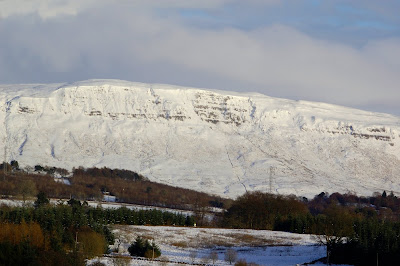 |
| Campsie Fells
|
 |
| Campsie Fells
|

On the way to Carbeth Inn (where we would stop for a coffee and a warm up), we passed this little Robin (
Erithacus rubecula).
+2.jpg) |
| Robin (Erithacus rubecula)
|
Robins are one of the few birds that sing right through the harshest winter months - possibly why they are associated with Christmas time. Both males and females sing at this time of year, defending their separate territories from intruders.


.jpg)


+female+3.jpg)


+2.jpg)


