Showing posts with label Boloria selene. Show all posts

Friday, 18 June 2010

Kilpatrick Hills, East/West Dunbartonshire

This is part 2 of my camping trip: the walk home!

As I mentioned in my last post, the midges were horrific! To my horror, when I awoke, I found that my tent was BLACK with midges - all just sitting patiently on the outer surface of my tent, waiting for me to emerge.

By 10am the midges had dispersed somewhat, enabling me to pack away my tent. Burncrooks valley is one of the wildest places in the Kilpatrick Hills: the natural woodland is mainly Alder, with some Birch, Rowan and Willow, and the forest merges naturally into shrubby old-growth heather and bracken on the hills at either side. Very few people walk this way (due to the lack of any paths) so there is never any litter!

Here are some moths I found in Burncrooks valley:

Angle Shades (Phlogophora meticulosa)
This is an Angle Shades moth in situ (above), it hasn't picked a very good hiding place. To demonstrate its brilliant bark camouflage, I moved it to a nearby Alder:

Angle Shades (Phlogophora meticulosa)
This beautiful moth is a common species and is polyphagous - meaning its larvae will eat almost all herbaceous plants. Its scientific name means 'The fearful fire-bearer' (Phlogo = fire + phora = to carry/bear: from Greek, meticulosa = timorous/fearful: Latin). This probably refers to the flame-like triangular markings on the forewings.

My 'Moths of West Dunbartonshire' blog has better photos of this species (from every angle!): http://themothzoo.blogspot.com/2010/07/angle-shades-phlogophora-meticulosa.html.

Four-dotted Footman (Cybosia mesomella)
The Four-dotted Footman (Cybosia mesomella) is a locally distributed species in Scotland. Wing colour ranges from white (like the specimen above) to golden yellow. The larvae are thought to feed mainly on the lichens which encrust heather.
Common Heath (Ematurga atomaria) female
The Common Heath (Ematurga atomaria) is a day-flying moth, common in moorland areas (the larvae feed on heathers (Calluna & Erica spp.) and clovers (Trifolium spp.). Wings are very variable and can be yellow with chocolate marbling, white with chocolate marbling (as in photos above) or unicolourous chocolate brown.
Silver-ground Carpet (Xanthorhoe montanata)
Easily disturbed from vegetation during the day, the Silver-ground Carpet (Xanthorhoe montanata) also flies at night. Look closely at this moth's wings to see the 'snowy mountain peaks' mentioned in its specific name 'montanata' (Latin).

I walked around the edge of Burncrooks reservoir and spotted some Aeshna dragonflies zooming around. Then I entered the pine plantation which borders the Kilmannan reservoir. There is a greater diversity of plant and animal species here than might be expected!

Although at first resembling an agave of some sort, this is a plantation spruce (Picea sp.) branch from above.
Spruce (Picaea sp.)
Spruce (Picaea sp.) needles have a very plastic astro-turf look:
Spruce (Picaea sp.)
Bird's-foot Trefoil (Lotus corniculatus) grows profusely at the forest edge, colonising the gravelly path when it can. It's one of the few native plants with orange flowers.
Bird's-foot Trefoil (Lotus corniculatus)
Ribwort Plantain (Plantago lanceolata)
Ribwort Plantain (Plantago lanceolata) is another waste-ground colonizer. One of my South American flatmates used to drink 'plantago tea' - it has medicinal qualities: the leaves are astringent/haemostatic (staunch bleeding) and the whole plant is rich in mucilage (especially the seeds) - with laxative/demulcent properties.
Large Red Damselfly (Pyrrhosoma nymphula)
Groundsel (Senecio vulgaris)


Groundsel's scientific name (Senecio vulgaris) means 'common old-man' (Senecio = old man, vulgaris = common/widespread: Latin) and the whole plant is hepatotoxic (damages the liver) so should not be eaten.
Tormentil (Potentilla erecta)
Tormentil has roots with a high tannin content and all parts of the plant (especially the root) are highly astringent, staunch bleeding and have antibiotic properties. Traditional uses for this plant include treatment of tooth-ache, mouth ulcers, to treat bed-wetting in children and colitis. Also, a red dye can be obtained from the roots.

I added some new plant species to my regional list: Thyme-leaved Speedwell (Veronica serpyllifolia), Heath Pea (Lathyrus linifolius) and (below) Trailing St-John's Wort (Hypericum humifusum).
Trailing St John's Wort (Hypericum humifusum)
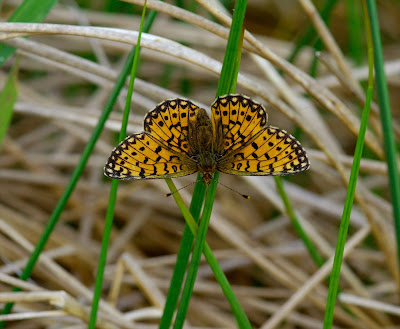
Small Pearl-bordered Fritillary (Boloria selene)
Marsh Lousewort (Pedicularis palustris) grows profusely on the rocky banks of Burncrooks reservoir (South-East side, near the inflowing river).
Marsh Lousewort (Pedicularis palustris)
Wire deer fences, rolled up

Around Duncolm, the rough grassland was covered with the silvery-white, feather-down seed-heads of Hare's Tail Cottongrass (Eriophorum vaginatum).

Hare's Tail Cottongrass (Eriophorum vaginatum)
Hare's Tail Cottongrass (Eriophorum vaginatum) 
Hare's Tail Cottongrass (Eriophorum vaginatum) with Duncolm behind, to left. 

We have 2 species of Cottongrass (Eriophorum sp.) in the Kilpatricks: Hare's Tail Cottongrass (Eriophorum vaginatum) has ONE cottony seed-head per stem, whilst Common Cottongrass (Eriophorum angustifolium) has multiple seed-heads per stem and has channelled leaves - a photo for comparison: https://blogger.googleusercontent.com/img/b/R29vZ2xl/AVvXsEjOPPompryfaDD-Uh978kx5riOYV2DHoImYidtWezZDER3Omp1yKnVmmECYyYwOKGGBMuCBp3BR7UftG3hFYoWXaiC4oTaXbst3kHmA71Q8dWSo1Y3n3jk_Y1d-JfhkBCHSzCfxaM9djDs/s400/cottongrass+(eriophorum).jpg.
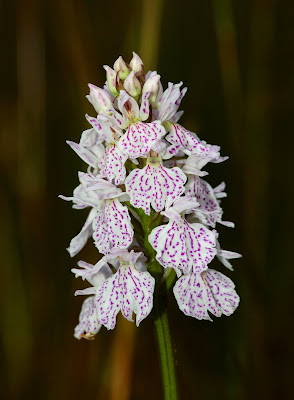
Heath Spotted Orchid (Dactylorhiza maculata) 

In nutrient-poor bogs plants use more unusual methods to obtain food: some becoming carnivorous.
Sundews capture their prey with the aid of sticky globules secreted from leaf tentacles. When an insect becomes trapped on this sugary dew, the leaf tentacles and leaf surface begin to wrap around the insect and secrete enzymes to digest it.
The photos below are of the Round-leaved Sundew (Drosera rotundifolia) which I found growing on the boggy grassland South of Duncolm.
Round-leaved Sundew (Drosera rotundifolia) with flower buds 
Round-leaved Sundew (Drosera rotundifolia) with prey

One of the sundew leaves above has already managed to trap a victim: it will supply the plant with a valuable source of nitrogen.

Here is an excellent photo demonstrating the ability of a sundew (Drosera anglica - the largest British sundew) to tackle larger prey (damselflies): http://commons.wikimedia.org/wiki/File:Drosera_anglica_ne2.jpg.

I stopped at the Test to have a drink and rest my tired feet. At this point I discovered that the soles were coming off my boots :(

Some nearby Blackface Sheep began making their snorting 'chirrit' alarm call at me: the sheep on the Kilpatrick Hills are almost feral and live on the moor all year round.


Wednesday, 1 July 2009

Kilpatrick Hills, West Dunbartonshire

Today I walked through the Kilpatrick Hills - from Little Round Top to the Test, around the Greenside Reservoir and then to the Northern side of the Cochno Reservoir. I was hoping to photograph some Small Pearl Bordered Fritillaries.

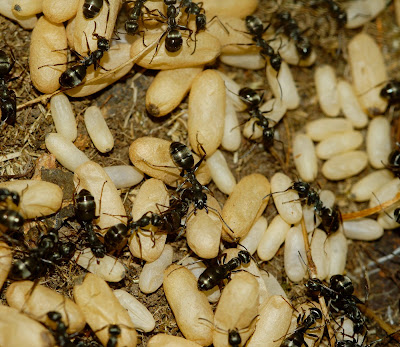
At Little Round Top I lifted some rocks, which revealed, amongst other things, a colony of Black Garden Ants (Lasius niger). I need to spend a day photographing this species in more detail, as they are extremely interesting.

In the photos below, worker ants (non-breeding females) are rushing to take the cocoons to a place of safety. Larvae of this species do not have a pupal stage but instead spin themselves silky cocoons - various stages can be seen in the photos.

Black Garden Ant (Lasius niger)
Black Garden Ant (Lasius niger) workers with cocoons
Black Garden Ant (Lasius niger)
Black Garden Ant (Lasius niger) workers with cocoons


This species is omnivorous and often 'milks' aphids for their honeydew. Lasius niger translates as 'Hairy black' (Lasius, from Greek lasios = hairy, and niger = black).
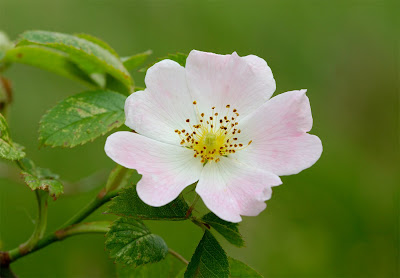
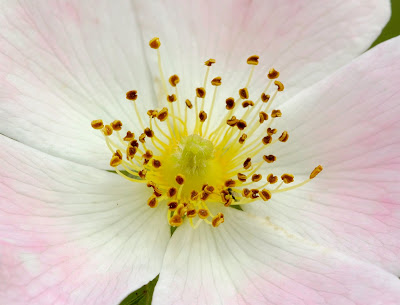
Dog Rose (Rosa canina)


The fruits of the Dog Rose (rosehips) can be made into jam, syrup or tea, and are rich in vitamins A,C and E (as well as flavonoids).

The meadow around Little Round Top was full of butterflies: dark-brown Ringlets (Aphantopus hyperantus), brown-orange Meadow Browns (Maniola jurtina), little orange-grey Small Heaths (Coenonympha pamphilus), Painted ladies (Cynthia cardui), shimmering Common Blues (Polyommatus icarus) and a few Green-veined Whites (Pieris napi).

Common Blue (Polyommatus icarus)
Common Blue (Polyommatus icarus) male
Common Blue (Polyommatus icarus)
Common Blue (Polyommatus icarus) male


Like many members of the Lycaenidae, the larvae of the Common Blue have an association with ants - the larvae produce a sticky secretion which ants find attractive and the larvae, in turn, recieve a degree of protection from the ants. Its scientific name means 'many-eyed icarus' (Poly = many + ommatus, from Greek omma = eyed, and icarus = from Greek mythology - who failed in his attempt to escape imprisonment; using wings made from feathers and wax; when he flew too close too the sun).

Ragged Robin (Lychnis flos-cuculi)
Red Clover (Trifolium pratense)


The leaves and young flowers of Red Clover can be eaten raw or cooked and the seeds can be sprouted for use in salads, soups etc. Red Clover, being a legume, is able to fix nitrogen through its symbiosis with Rhizobium bacteria found in root nodules.

Also flowering right now are Marsh Hawksbeard (Crepis paludosa) and Catsear (Hypochoeris radicata) - just below the Test.
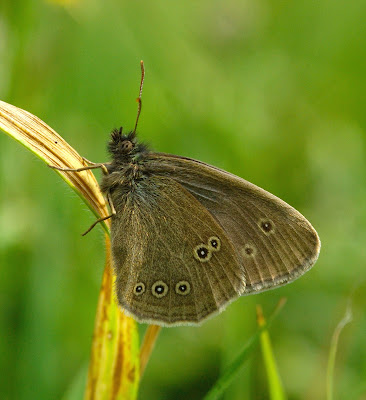
Ringlet (Aphantopus hyperantus)
Mouse-ear hawkweed (Hieracium pilosella)
Mouse-ear Hawkweed (Hieracium pilosella)


Mouse-ear Hawkweed can be easily identified by its solitary lemon-yellow flowers held atop erect, leafless stems, and by its hairy leaves held close to the ground in a basal rosette. This plant was traditionally used to treat a variety of respiratory complaints such as asthma, bronchitis and whooping cough, although the effectiveness has never been proven scientifically. It is known to be strongly diuretic.

Wild Pansy (Viola tricolor)


Also known as Heartsease, the Wild Pansy is the ancestor of the garden pansy and is highly variable in colouration. The flowers and young leaves (high in vitamins A & C) can be eaten raw in salads.

At the Test there was the usual flock of Reed Buntings (Emberiza schoeniclus).
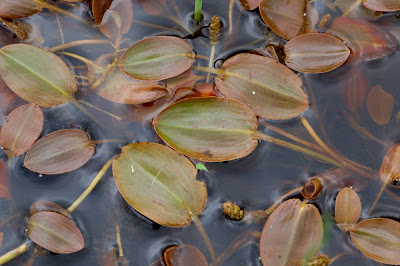
Bog Pondweed (Potamogeton polygonifolius)
fern

I explored the far side of the Test, along the crumbling old dry stone wall and managed to catch a plump, pregnant Common Lizard (Lacerta vivipara). No Slowworms though :(

Common Lizard (Lacerta vivipara)
Common Lizard (Lacerta vivipara) pregnant female
English Stonecrop (Sedum anglicum)


I crossed the heath to the North of the Test and continued towards the Greenside Reservoir where I took a detour around to avoid a group of teenage boys with quadbikes. The reedy edges of the Greenside were buzzing with damselflies - Large Red (Pyrrhosoma nymphula) and Common Blue (Enallagma cyathigerum).

Common Blue Damselfly (Enallagma cyathigerum)
Common Blue Damselfly (Enallagma cyathigerum) male


The Common Blue Damselfly (Enallagma cyathigerum) can be distinguished from similar species by the characteristic triangular black marking on the 2nd abdominal segment (pointing tailwards). This is refered to in the scientific name: 'cup-bearing' (Cyathi = cup/goblet in Greek + gerum = to bear/carry). It also has broad antehumeral stripes and is a brighter blue than similar species

There are at least 9 species of dragonfly & damselfly in West Dunbartonshire. I have found the best sites to be: the Greenland Reservoirs, the Lily Loch, Burn Crooks valley, Little Round Top, the Test, the disused mines near the Kilmannan Reservoir, and the Forth and Clyde Canal.

Hairy Stonecrop (Sedum villosum) was growing on the Western bank of the Greenside.
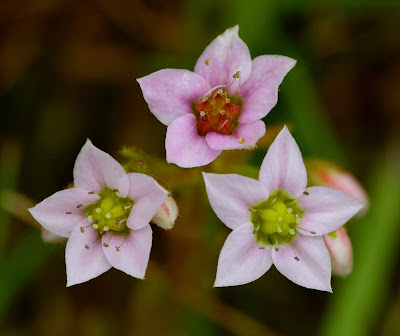
Hairy Stonecrop (Sedum villosum)

Because I love rusty metal (!):

rust

I went to have a look at the young forest (part of a native woodland regeneration scheme) between the Greenside and the Jaw/Cochno. The grasses have grown luxuriously thick because the tall deer fence keeps out deer, sheep and most humans. The forest is still at a shrubby stage - an intermediate habitat which will attract species of its own.

While I was walking, a family of Whinchats (Saxicola rubetra) followed me along the fence. In the grass I found a large Common Toad (Bufo bufo). Lousewort (Pedicularis sylvatica) is flowering here.

The air was heavy, hot and humid and the sky overcast. I never get used to this sticky almost-tropical weather that we rarely experience in Scotland. It began to rain and the cool raindrops were so refreshing!

Snowy white, magenta-speckled Heath Spotted Orchids (Dactylorhiza maculata) were growing amid the damp grasses.

Heath Spotted Orchid (Dactylorhiza maculata)
Common Cottongrass (Eriophorum angustifolium)

I was mobbed by a pair of very loud Common Gulls (Larus canus) at the Cochno Reservoir, so I presume they must have a nest nearby. I stopped at the Northern tip of the Cochno Loch, where the little burn emerges from the forestry plantation. Here I found plenty of Small Pearl Bordered Fritillaries (Boloria selene) and decided to spend the rest of the day photographing them.

This species, along with Green Hairstreaks and Common Blues, are my favourite butterflies. The upper-sides of their wings are bright orange with delicate black latticing, trimmed with cream, and the under-sides are patterned like a mis-matched jig-saw in shades of white, cream, gold and rusty-orange. I followed them devotedly as they went from thistle to thistle, dancing with each other and landing every now and again on Bracken fronds to bask.

Small Pearl Bordered Fritillary (Boloria selene)
Water Avens (Geum rivale)
Painted Lady (Cynthia cardui)

I found another Common Lizard at the top of the Cochno Reservoir just before I headed home.

Back at my parent's house there were 2 Peach Blossom moths (Thyatira batis).
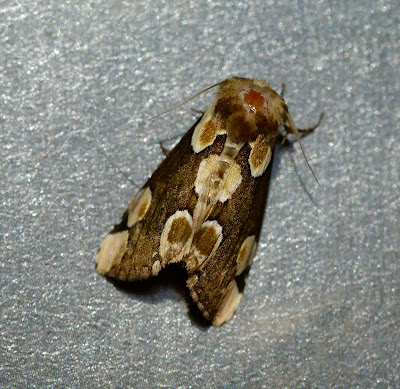
Peach Blossom (Thyatira batis)