My walk today took me from Duntocher to Little Round Top and then the Test (the marsh to the East of the Slacks).
The Bluebells haven't yet begun to flower. I've noticed that the spring flowers are very late this year, probably due to the very harsh winter. At Little Round Top there are good numbers of Orange-tip butterflies.
 |
| Marsh Marigold (Caltha palustris)
|
Marsh marigold is not related in any way to garden marigolds (which belongs to the daisy family: Asteraceae); rather, it is a member of the buttercup family (Ranunculaceae).
Marsh Marigold's scientific name Caltha palustris is a straight-forward Latin translation of its common name: 'Marigold of-marshes' (Caltha = marigold, and palustris = of marshes).
 |
| Marsh Marigold (Caltha palustris) with Yellow Flag roots (Iris pseudacorus) |
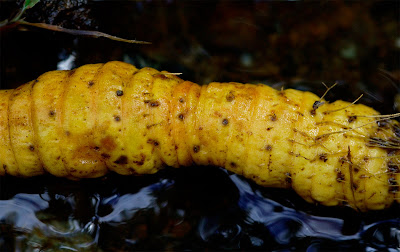 |
| Yellow Flag roots (Iris pseudacorus) |
The orange, fibrous roots of Yellow Flag (Iris pseudacorus) are poisonous but supposedly yield a black dye (when mixed with iron sulphate).
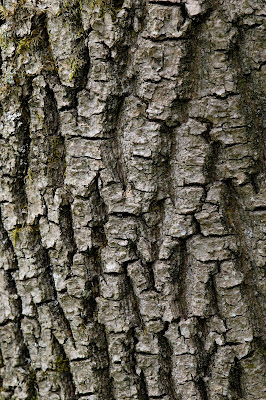 |
| Ash (Fraxinus excelsior) bark
|
Ash has a rough, grey bark with fissures forming a criss-crossing pattern of Xs.
Little Round Top wood is an impenetrable tangle of thorny Sloe bushes, massive Ash trees and thickets of Elder and Hazel. Many of the gigantic Ash trees have succumbed to rot and have fallen down in the last few years, their colossal trunks form a complex head-high obstacle course. As I sat on the mossy bark of one of these felled leviathans, I watched Treecreepers scaling the cracked-skin of still-standing trees and Long-tailed Tits zipping about high in the canopy.
 |
| Wavy Bittercress (Cardamine flexuosa)
|
Wavy Bittercress (Cardamine flexuosa) can be distinguished from its close relative Hairy Bittercress (Cardamine hirsuta) by the presence of 6 stamens per flower (see above photo: Hairy Bittercress has 4) and by the position of the young seed-pods BELOW the flowers (Hairy Bittercress has seed-pods which extend ABOVE the level of the unopened flowers).
Both Bittercress species are edible - the leaves and flowers have a hot, peppery taste.
 |
| Bracken (Pteridium aquilinum)
|
 |
| Bracken (Pteridium aquilinum)
|
 |
| Black Poplar hybrid (Populus nigra x ?) |
Each tree species has its own distinctive bark texture and colour, a characteristic pattern of ridges, like a fingerprint.
The Black Poplar hybrid (Populus nigra x ?) growing below Little Round Top is a non-native tree. The bark is grey, fissured and heavily 'crackled' like pottery glaze. There are also many 'eyes' in the bark.
The fresh bark of all poplars (and willows) contains salicin (C13H18O7), an alcoholic β-glycoside, which is similar in structure to acetylsalicylic acid (aspirin) and has pain-relieving, fever-reducing, anti-inflammatory and anti-septic properties.
+2.jpg) |
| Ground Ivy (Glechoma hederacea)
|
.jpg) |
| Ground Ivy (Glechoma hederacea) |
When crushed, Ground Ivy releases a powerful herby aroma, which I find very pleasant. Herbal tea can be made from the leaves, which are purported to be anti-inflammatory, astringent and aid digestion. In the past, this plant was used to flavour beer instead of/alongside Hops.
 |
| Burdock (Arctium lappa)
|
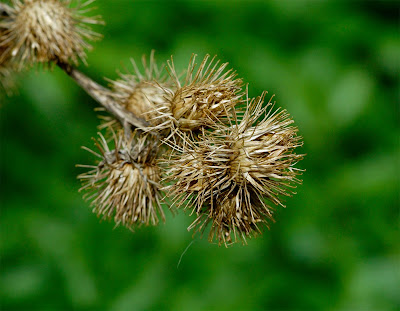 |
| Burdock (Arctium lappa)
|
Climbing under some of the fallen tree trunks, I managed to get Burdock burrs on my clothing: they are surprisingly difficult to extract, the voracious hooks burrowed into my fingertips as I tried to remove them. These were the inspiration for George de Mestral's Velcro.
Burdock roots are edible when cooked and are often used in Asian cooking.
In Japan, Burdock is known as 'gobo' and is used to make a number of dishes including 'kinpira gobo':
http://justbento.com/handbook/recipes-side-dishes-and-space-fillers/classic-kinpira-gobo.
Of course, the roots can also be incorporated into soups and stir-frys, or mashed & mixed with flour and fried in a similar fashion to potato scones.
Burdock roots contain inulin, a polysaccharide which cannot be directly digested by the body (gut bacteria digest inulin and release fatty acids which we can absorb). Because of this indirect digestion (gut bacteria release methane through fermentation), inulin may cause bloating/wind in those unaccustomed to it.
 |
| Common Mouse-ear (Cerastium fontanum)
|
+2.jpg) |
| Common Mouse-ear (Cerastium fontanum)
|

Hazel (
Corylus avellana) has a beautiful bark: pale greyish-brown and smooth, with a slight metallic sheen and a delicate morse-code of ridges.
 |
| Hazel (Corylus avellana)
|
 |
| Hazel (Corylus avellana) |
Elder has a similar bark pattern to Ash, but the bark is dull, beige-brown and has a distinctly corky feel to it. Elder wood is very light-weight since most of the interior is filled with a spongy white pith.
 |
| Elder (Sambucus nigra) |
On my way from Little Round Top to the Test, a Brown Hare lept up from the marshy grass and galloped off. It left a flattened patch, or 'form', in the grass, from which I was able to collect a sample of hair/hare.
A pair of Whinchats (Saxicola rubetra) are breeding at the rocky Northern end of the Test:
+2.jpg) |
| Whinchat (Saxicola rubetra) female |
Whinchats, like Wheatears, migrate to the UK from Africa for the summer months (in contrast, Stonechats remain all winter). The thrush family (Turdidae) has been largely reorganized in recent years and many species moved to the Muscicapidae (Old Word Flycatchers); including both Whinchats and Wheatears.
In the moorland North of the Test, I found this unfortunate wee fellow, a Common Shrew (Sorex araneus):
 |
| Common Shrew (Sorex araneus) dead
|
These tiny mammals are surprisingly fierce! As a child I remember finding a Common Shrew whilst turning over rocks in search of wildlife: it didn't try to run away, but stood its ground and bared every sharp little tooth in its head. I changed my mind quickly about capturing it! Shrews are solitary, coming together only to mate and defending their territories vigorously from other shrews.
The saliva of some shrew species is thought to contain a toxin which causes inflammation and a painful burning sensation, hence the Common Shrew's scientific name 'Sorex araneus': Sorex = shrew, and araneus = spiders (as in, venomous).
Edward Topsell's The History of Four-footed Beasts and Serpents, a bestiary published in two parts in 1607 & 1608, has this to say: "It is a ravening beast, feigning itself gentle and tame, but being touched it biteth deep and poysoneth deadly. It beareth a cruel minde, desiring to hunt anything, neither is there any creature that it loveth".
 |
| (Courtesy of Special Collections, University of Houston Libraries) |

.jpg)


.jpg)


+2.jpg)
.jpg)


+2.jpg)


+2.jpg)


