Friday, 22 July 2011

Kilpatrick Hills, West Dunbartonshire

I walked from Duntocher to the Test again, taking the longer route above Little Round Top Wood to avoid the boisterous bullocks in the fields below. This route is short yet encompasses a wide variety of habitats (Ash/Hazel woodland, gorse scrub, dry grassland, damp flower-rich meadows, moorland and reedy willowy marshland).

Marsh Ragwort Senecio aquaticus
Marsh Ragwort (Senecio aquaticus)

Marsh Ragwort Senecio aquaticus
Marsh Ragwort (Senecio aquaticus)
Despite receiving lots of bad press, both Marsh Ragwort (Senecio aquaticus) and Common Ragwort (Senecio jacobaea) are native plants and are a vital food source for many insects (for example, the plume moth Platyptilia isodactylus feeds ONLY on Marsh Ragwort).

Meadowsweet Filipendula ulmaria
Meadowsweet (Filipendula ulmaria)

Meadowsweet is a sweet scented, non-toxic plant with analgesic (pain relieving) and antiseptic properties. Salicylic acid extracted from Meadowsweet was used by chemists at Bayer AG to synthesize a new painkiller - acetylsalicylic acid - which they named aspirin (derived from Meadowsweet's old genus name rearranged: Spiraea).

Yarrow white Achillea millefolium
Yarrow (Achillea millefolium)

Yarrow white Achillea millefolium
Yarrow (Achillea millefolium)

Yarrow has flat-topped clusters of potently aromatic flowers coloured either milky white or various shades of pink (from pale candyfloss to a deep raspberry icecream).

One of the most highly regarded plants in herbal medicine, Yarrow is antimicrobial/antiseptic, anti-inflammatory, antispasmodic, choleretic (increasing bile secretion), vasodilatory and promotes the healing of wounds.
Its feathery leaves are mentioned in its other common names Milfoil and Thousand-leaf and also in the species name millefolium (mille = thousand + folium = leaf: Latin).

There were plenty of Meadow Brown butterflies on the wing and I managed to photograph one with its wings open for a change, revealing the foxy-orange patches and black eye-spots.

Meadow Brown Maniola jurtina female
Meadow Brown (Maniola jurtina) female

This individual is a female, males are a darker brown with much smaller orange patches.

Harebell Campanula rotundifolia
Harebell (Campanula rotundifolia)

In late summer the moorland is at its most vivid: heather is freshly magenta-purple or lilac and the wild grasses have dried to a crispy gold. Above the Test there is mostly Bell Heather (Erica cinerea) with some Cross-leaved Heather (Erica tetralix) in the boggier parts.

moorland grasses golden heather

I followed the old track (overgrown with Gorse) that leads down from the Test southeast to Little Round Top. At a marshy point to the side of this path I discovered a plant which I have never seen before: Knotted Pearlwort (Sagina nodosa).

Knotted Pearlwort Sagina nodosa
Knotted Pearlwort (Sagina nodosa)

Knotted Pearlwort Sagina nodosa
Knotted Pearlwort (Sagina nodosa)

The key features identification features of Knotted Pearlwort are:

  • Stubby bunches of leaf shoots which form 'knots' along the stems
  • Completely white (unnotched) petals twice as long as sepals (the green flaps underneath petals). 
  • 5 white centrally-placed styles surrounded by 10 white stamens.  
Knotted Pearlwort's scientific name translates as 'Fodder, knotted' (sagina = fodder, nodosa = knotted: Latin).

Sunday, 10 July 2011

Kilpatrick Hills, West Dunbartonshire

The route I followed on today's (short) walk was: Duntocher to the Test (OS map grid reference: NS 475 743) via Little Round Top Wood (NS 476 735), this time crossing the marshland meadow above it.

Bittersweet Solanum dulcamara
Bittersweet (Solanum dulcamara)

Bittersweet (also known as Woody Nightshade) was growing through a hedge at the side of Beeches Road (field boundary near crossroads).

Bittersweet is a close relative of Potato, Tomato and Aubergine (all these plants belong to the genus Solanum and all have poisonous foliage). Unlike its partially edible relations: all parts of Bittersweet (including the attractive fruits) contain the glycoalkaloid poison solanine and cause nausea and stomach cramps if consumed.

I found 3 Six-spot Burnet moths in the rough grassland above Little Round Top Wood, they all looked a bit worn (probably the end of their flight period).
These day-flying moths produce cyanogenic glucosides and can also sequester those produced by their foodplant (Common Bird's-foot Trefoil). When broken down, the cyanogenic glucosides release poisonous hydrogen cyanide: their crimson-spotted wings are an aposematic warning to predators.

Six-spot Burnet Zygaena filipendulae
Six-spot Burnet (Zygaena filipendulae)

Hairy Thyme Thymus praecox
Hairy Thyme (Thymus praecox)

Surprisingly few bees around at the moment - I've scarcely seen any this summer, even the dense clumps of thyme were empty.

At the Test I found a Sparrowhawk kill: a clump of feathers which probably belonged to a Meadow Pipit.

I also found this large female Drinker moth:

Drinker moth Euthrix potatoria female
Drinker moth (Euthrix potatoria) female

Drinker moth Euthrix potatoria female
Drinker moth (Euthrix potatoria) female

Drinker moth Euthrix potatoria female laying eggs
Drinker moth (Euthrix potatoria) female, laying eggs

Drinker moth Euthrix potatoria female laying eggs
Drinker moth (Euthrix potatoria) female, laying eggs

Difficult to photograph due to the blustery wind!
The irritatingly hairy caterpillars of this moth feed on wild grasses and reeds: these eggs will hatch in a month's time and the larvae will spend the winter in their larval stage (pupating the following summer).

In the sheep-grazed grassland south of the Test, I found the diminutive white flowers of Fairy Flax (Linum catharticum): a non-edible, wild relative of Flax (the plant from which linseed is obtained).

Fairy Flax Linum catharticum
Fairy Flax (Linum catharticum)

Monday, 20 June 2011

Kilpatrick Hills, West Dunbartonshire

Today I walked to the hidden valley of Haw Craig (via the Humphrey Road) and followed the treeline north of the Hill of Dun, to Glenarbuck and the Triangle Reservoir.

I found a dead Stoat at the bottom of Beeches Road, close to the collapsed WW2 bomb shelter (now a pile of concrete slabs).

As I crossed the sheep field above Haw Craig, a Brown Hare started up from under my feet - a magnificently large individual.

Sitting on the cliff overlooking Haw Craig, I heard harsh chattering and caught a brief flash of colour as a Jay swiftly glided from one tree to another. They had good reason to be nervous: I soon spotted the steely-grey back of a male Sparrowhawk slipping stealthily between the Hawthorn scrub.

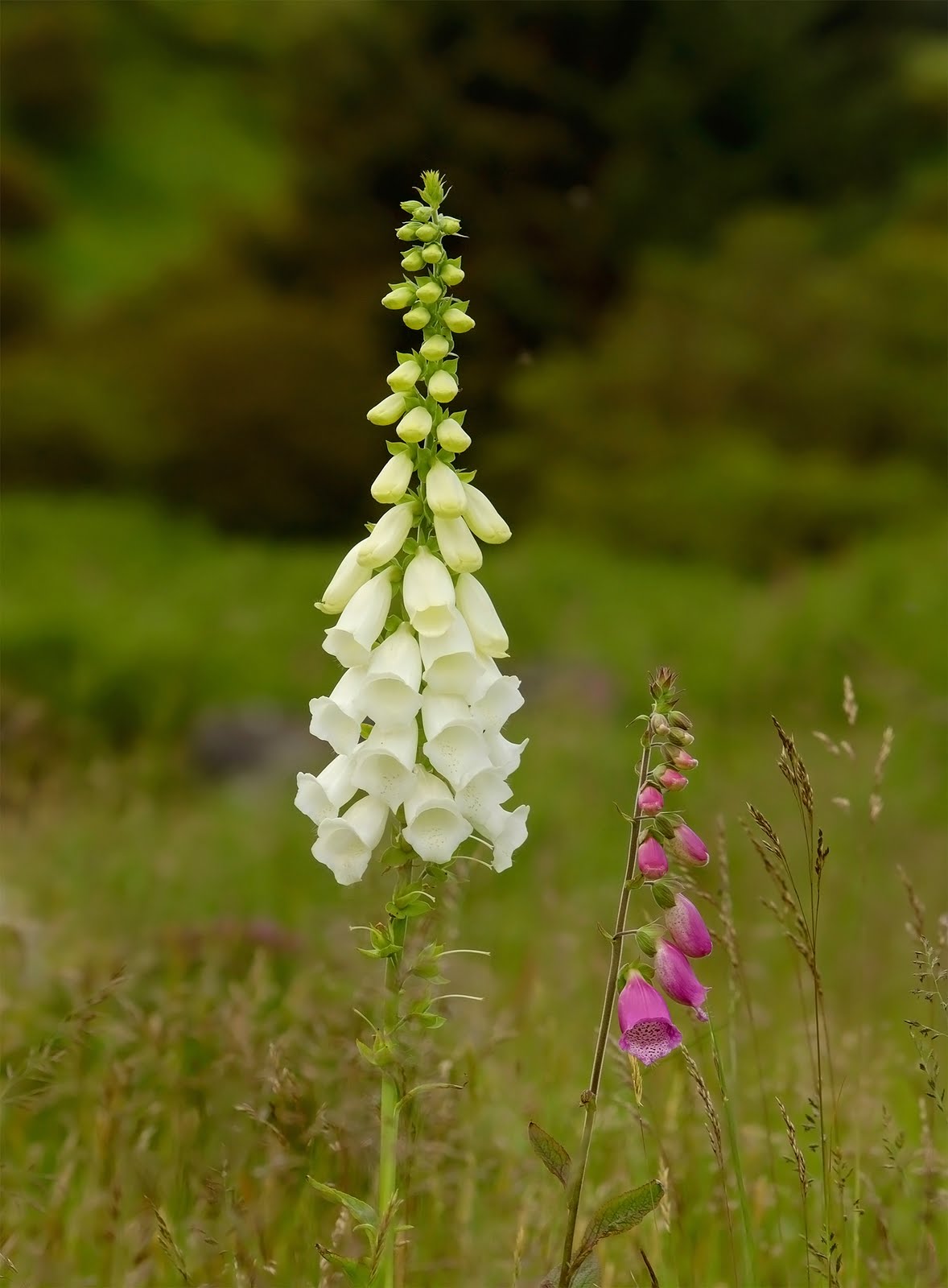
Tall spikes of magenta Foxgloves filled the valley and Hairy Thyme furnished the tops of boulders and loose scree with pink.

Foxglove Digitalis purpurea
Foxglove (Digitalis purpurea)
Foxglove Digitalis purpurea
Foxglove (Digitalis purpurea)
Foxglove Digitalis purpurea white
Foxglove (Digitalis purpurea) white mutation
Foxglove Digitalis purpurea white
Foxglove (Digitalis purpurea) white mutation
Foxglove Digitalis purpurea colours
Foxglove (Digitalis purpurea) colour variations

Foxglove is deadly poisonous, even in small quantities. The entire plant contains cardiac glycosides (particularly digoxin) which cause dizziness/nausea, visual disturbances and potentially dangerous changes in heart rate and rhythm (digoxin is sometimes used medicinally to treat heart conditions).
Foxglove's scientific name means 'Of-the-fingers purple' in Latin (Digitalis = of the fingers & purpurea = purple) referring to the way in which the flowers can be fitted thimble-like onto the fingertips.

Amongst the foxgloves I found this toothless old fox skull:

Fox skull vulpes vulpes
Fox skull (Vulpes vulpes)

Flat or concave post-orbital processes (the projections at the upper rear of the eye socket) indicate that this is a fox's skull.
In dogs, the post-orbital processes are convex and elevated above the muzzle (forming a distinct stop between forehead and base of nose).

An excellent guide to skull identification can be found here: http://www.btinternet.com/~alison.gilsland/hedbone/lists.htm.

Hairy Thyme Thymus praecox
Hairy Thyme (Thymus praecox)
Hairy Thyme Thymus praecox
Hairy Thyme (Thymus praecox)

Hairy Thyme, one of several species of wild thyme, is strongly aromatic when crushed and is highly attractive to bees.
This species can be used in recipes in exactly the same way as cultivated varieties, though the flavour is weaker. Thyme also has medicinal properties: it contains thymol (aka 2-isopropyl-5-methylphenol) which is strongly antiseptic and antimicrobial.

Orchid Beetles (Dascillus cervinus) were present in large numbers on the patches of thyme.

Broom Cytisus scoparius
Broom (Cytisus scoparius)

Broom (Cytisus scoparius) is a leguminous, nitrogen-fixing shrub belonging to the Faboideae subfamily (alongside Clovers and Gorses). As its common name suggests, the slender branches of this shrub were once used as brooms: the species name 'scoparius' is Latin for 'the sweeper'.

Wood Avens Geum urbanum
Wood Avens (Geum urbanum)

Wood Avens, also known as Herb Bennet, has edible leaves which can be cooked into soups & stews. The roots; which have an aromatic clove-like taste; can be boiled into a beverage or used to flavour soups.

Wood Avens Recipes: 

Wood Avens & Dandelion Coffee (from www.bbc.co.uk)
Woodland Spiced Rosehip and Beetroot Soup (from www.bbc.co.uk)
Fried Wood Avens Leaves (from www.eatweeds.co.uk)

Common Blue Damselflies (Enallagma cyathigerum) are beginning to emerge where the river runs through Haw Craig.

The Triangle Reservoir was rather quiet: I saw only 1 Sand Martin.

On the stony banks of the reservoir I nearly managed to catch a vole. Then I somehow managed to fall INTO the Triangle Reservoir (oops!) whilst observing the thick black mass of tadpoles congregated at the bottom.

On my return home I found this guy:

Poplar Hawkmoth Laothoe populi male
Poplar Hawkmoth (Laothoe populi) male

Unusually, in this species the hindwings are held in front of the forewings.

Poplar Hawkmoth Laothoe populi male
Poplar Hawkmoth (Laothoe populi) male
Poplar Hawkmoth Laothoe populi male
Poplar Hawkmoth (Laothoe populi) male
Poplar Hawkmoth Laothoe populi male
Poplar Hawkmoth (Laothoe populi) male - wing detail
Poplar Hawkmoth Laothoe populi male
Poplar Hawkmoth (Laothoe populi) male 
Poplar Hawkmoth Laothoe populi male
Poplar Hawkmoth (Laothoe populi) male
Poplar Hawkmoth Laothoe populi male
Poplar Hawkmoth (Laothoe populi) male

Common, but still an impressive moth: about 5cm in length from wing to wing! This species lacks a functional proboscis and therefore cannot feed during adulthood.

Poplar Hawkmoths can be sexed easily: males have narrow, blunt-tipped abdomens while females have pointed abdomens.

Monday, 6 June 2011

Kildonan, Isle of Arran

Arran has a very varied geology, which has given rise to a rich diversity of shore types. The shores at Kildonan are a mixture of white sandy bays, shingle beaches and basalt dykes (with plenty of rockpools).

Kildonan Port a'Ghille Ghlais raised shore
Raised Beach near Kildonan at Port a'Ghille Ghlais

The luxuriantly vegetated cliffs of the hinterland are a classic example of a post-glacial raised shore, formed when land rose after the melting of glacial ice sheets, whose weight previously kept this land depressed.

Kildonan Tertiary basalt dykes
Tertiary basalt dykes at Kildonan

Basalt dykes and sills form tall, lichen-crusted rock-walls which chop the shore into segments and extend into the sea. These intrusions were formed in the Tertiary when molten magma intruded into pre-existing rock layers, in this case Triassic mudstone (sedimentary rock formed from clay or mud).

When many dykes arise from a single volcanic event they form what is known as a 'dyke swarm', of which Kildonan has one of the best examples in the world.

More in-depth info on Kildonan's geology can be found at these sites:

Coastal Zone Assessment Survey of Port a' Ghille Ghlais to Kildonan (Map 5) produced by SCAPE & Historic Scotland.

Site Report by the Joint Nature Conservation Committee (JNCC)

Pladda Ailsa Craig
Isle of Pladda (left) and the Ailsa Craig (right) from Kildonan
Pladda Ailsa Craig
Isle of Pladda with Ailsa Craig behind

Pladda
Lighthouse on Pladda

The Isle of Pladda is a flat-topped volcanic sill and was formed when magma flowed sideways between pre-existing rock layers. Once cooled, this magma was harder than surrounding rocks and resisted erosion, forming a cliff above softer rocks. It has had a lighthouse since 1790, though the current building dates from around 1830.

Ailsa Craig
Ailsa Craig

The Ailsa Craig (also known as Paddy's Milestone) is a sharply conical volcanic plug composed mostly of microgranite (a very hard, fine-grained granite) which contains the minerals riebeckite and aenigmatite. It has the 3rd largest Gannet colony in the UK and many of these birds can be seen fishing around the coasts of Arran.

Kildonan is a great place to see Common Seals (Phoca vitulina): a large colony is present all year and the seals seem surprisingly tolerant of human presence. As we approached the seals we could hear their snorts, grunts and wails echoing off the green cliffs curving round the bay.

Dog-owners should keep their pets on a leash along this stretch of shore to avoid disturbing the seals, as they haul out very close to the coastal path.

Common Seal Phoca vitulina
Common Seal (Phoca vitulina)
Common Seal Phoca vitulina
Common Seal (Phoca vitulina)

Common Seal Phoca vitulina
Common Seal (Phoca vitulina)

Common Seal Phoca vitulina
Common Seal (Phoca vitulina)
Common Seal Phoca vitulina
Common Seal (Phoca vitulina)

Common Seals (Phoca vitulina) can be distinguished from Grey Seals (Halichoerus grypus) by the following features:

  • V-shaped nostrils (the Grey Seal has almost parallel nostrils).
  • Rounded head with short snub-nosed muzzle. Pronounced dip between forehead and muzzle (the Grey Seal has a long 'Roman nosed' muzzle and a flat forehead). 
  • Eyes positioned on the front of the face, closer to the nose than the back of the head (Grey Seals have their eyes positioned slightly on the sides of the head, halfway between nose and back of head).
  • Fur is very finely and uniformly mottled with pale outlines/rings around darker grey spots (Grey Seals have more strikingly marked, blotchier coats often with sharply contrasting patterning).
Common Seals are the smaller of the two species, weighing 45-105 kg (males are only slightly bigger than females). Unlike Grey Seals, Common Seals are born without a woolly white fetal coat (called lanugo) as it is shed in the womb.

The Common Seal's scientific name means 'calf-like seal' (Phoca = seal: from Latin which is derived from the Greek phoke, vitulina = calf-like: Latin).

Common Seal Phoca vitulina
Common Seal (Phoca vitulina)

Seals have highly sensitive whiskers known as vibrissae (those on the muzzle are mystacial vibrissae) which are used in the tactile detection and identification of prey.

Common Seal Phoca vitulina
Common Seals (Phoca vitulina)

Seals may look sluggish and ungainly on land but in the water they're amazingly graceful and possess an amazing array of adaptations to their marine habitat including the ability to fully collapse their lungs when diving, the ability to drink seawater and the presence of myoglobin in their muscles (which has a 40% higher oxygen-carrying capacity than haemoglobin).

Common Seal Phoca vitulina
Common Seals (Phoca vitulina)

Some of these Common Seals will be heavily pregnant females and will give birth over the next few weeks (Grey Seals pup at a different time of year: from September til early December).

Common Gull Larus canus first-summer
Common Gull (Larus canus) first-summer

We found an Oystercatcher's nest on the upper shore, it contained four cream eggs marked with blackish speckles and scribbles - the parent quickly and quietly returned to incubate once we were a few metres away.

A quick list of some of the birds seen today in Kildonan bay: a Curlew, 3+ pairs of Oystercatchers, a Hooded Crow, 2 Gannets, countless Rock Pipits, numerous Common and Herring Gulls, 5 Shelduck, 3 Merganser and a Buzzard.

Common Stork's-bill Erodium cicutarium
Common Stork's-bill (Erodium cicutarium)


Common Stork's-bill is a delicate pink-petalled flower related to geraniums, so-named because its long seed pods supposedly resemble storks' bills.

The seeds of this plant each possess a long bristle (known as an awn) which gives them the unusual ability to bury themselves. These awns, although composed of dead cells, are hygroscopically-active: they straighten when wet and coil into corkscrew helices when dry.
Coiling of the awn causes the seed to be fired from the seedpod and the motor action which results from the coiling and uncoiling of the awn causes the seed to move across the ground surface - until it falls into a crevice - and then enables it to drill itself into the soil.

A detailed account of this unusual process can be found here.

Dove's-foot Crane's-bill Geranium molle
Dove's-foot Crane's-bill (Geranium molle)
Hemlock Water Dropwort Oenanthe crocata
Hemlock Water Dropwort (Oenanthe crocata)
Hemlock Water Dropwort Oenanthe crocata
Hemlock Water Dropwort (Oenanthe crocata)
Hemlock Water Dropwort Oenanthe crocata
Hemlock Water Dropwort (Oenanthe crocata)

Hemlock Water Dropwort has leaves which smell appetisingly of Celery and bear a strong likeness to Lovage, however the whole plant (particularly the tuberous root) is deadly poisonous. It contains oenanthetoxin which affects the central nervous system, causing severe convulsions and in many cases, death.

How to Identify Hemlock Water Dropwort:

  • The whole plant is entirely hairless.
  • Leaves are 3-4 pinnate, toothed, slightly glossy and parsley-scented.
  • Stout stem is grooved.
  • Flowers are white and possess both upper and lower bracts.
3-4 pinnate = leaves are composed of leaflets arranged along an axis, each of which is further subdivided into leaflets which are themselves subdivided (and again for 4-pinnate leaves).

Northern Marsh Orchid Dactylorhiza purpurella
Western Marsh Orchid (Dactylorhiza purpurella)
Northern Marsh Orchid Dactylorhiza purpurella
Western Marsh Orchid (Dactylorhiza purpurella)
Rock Arch
Sea Milkwort Glaux maritima
Sea Milkwort (Glaux maritima)
Sea Milkwort Glaux maritima
Sea Milkwort (Glaux maritima)
Smooth Hawksbeard Crepis capillaris
Smooth Hawksbeard (Crepis capillaris)
Smooth Hawksbeard Crepis capillaris
Smooth Hawksbeard (Crepis capillaris)
Rock Pipit Anthus petrosus
Rock Pipit (Anthus petrosus)
Wren Troglodytes troglodytes
Wren (Troglodytes troglodytes)
Wren Troglodytes troglodytes
Wren (Troglodytes troglodytes)
Wren Troglodytes troglodytes
Wren (Troglodytes troglodytes)
Wren Troglodytes troglodytes
Wren (Troglodytes troglodytes)
Wren Troglodytes troglodytes
Wren (Troglodytes troglodytes)

I followed this little Wren as it hopped over boulders and deftly snatched insects out of the air.

Male Wrens are polygamous: each male builds a series of nests on his territory and tries to entice females to visit them: female Wrens prefer males who have more nests.
A female who is impressed with his collection of 'cock's nests' will mate with him and line a nest with feathers before laying her eggs. The male will then set about attracting another female to another one of his nests (the females incubate the eggs & do most of the young-rearing).

lichens
Lichens - Lecanora rupicola?
lichens
Lichens - Lecanora rupicola?

As they compete for space, these lichens form a beautiful map-like pattern of crackled continents with boldly demarcated borders.

I found them growing on boulders in the supralittoral or 'splash zone' of the upper shore - I think they *might* be Lecanora rupicola.

Orange-tip female Anthocharis cardamines
Orange-tip (Anthocharis cardamines) female

We walked back along the bay, until we reached Kildonan Hotel: to the side of the carpark there is a huge, rusty propeller leaning against the wall of a white-washed boathouse. House Sparrows nest in gaps under the roof.

House Sparrow Passer domesticus male
House Sparrow (Passer domesticus) male
House Sparrow Passer domesticus male
House Sparrow (Passer domesticus) male
House Sparrow Passer domesticus male
House Sparrow (Passer domesticus) male
House Sparrow Passer domesticus male
House Sparrow (Passer domesticus) male
Brown-lipped Banded Snail Cepaea nemoralis hyalozoate yellow
Brown-lipped Banded Snail (Cepaea nemoralis)

The Brown-lipped Banded Snail (Cepaea nemoralis) is one of two Cepaea species found in Britain (the other being Cepaea hortensis - the White-lipped Banded Snail). Due to the extreme polymorphism of shell patterning and colour found in both species, they can only be identified conclusively by dissection. However, most Brown-lipped Snails have a brown lip to their shells.

Studies on the genetics of shell colour and pattern in Cepaea nemoralis (here and here) have demonstrated that brown shell colour is dominant over both pink and yellow, that pink colouration is dominant over yellow, unbanded is dominant to banded patterns, and that darker banding is dominant over paler banding.

Evolutionmegalab.org has excellent photos of the various colour morphs.

My specimen is a yellow, hyalozonate (transparent banded) individual (very faint double banding is visible in the full-size photo). Some shell morphs provide better camouflage in certain habitats - yellow snails are more common in grassland and darker snails predominate in woodland. Shell colour also affects the thermal properties of a shell: lighter (yellow) shells reduce heat absorption.

I collected lots of holey stones from the shingle shore between Port a'Ghille Ghlais and Bennan Head:

piddock holes Hiatella arctica pebble
Pebbles with bivalve (Hiatella arctica?) bore holes
piddock holes Hiatella arctica pebble
Pebbles with bivalve (Hiatella arctica?) bore holes
piddock holes Hiatella arctica pebble
Pebbles with bivalve (Hiatella arctica?) bore holes
piddock holes Hiatella arctica pebble
Pebbles with bivalve (Hiatella arctica?) bore holes
piddock holes Hiatella arctica pebble
Pebbles with bivalve (Hiatella arctica?) bore holes
piddock holes Hiatella arctica pebble
Pebbles with bivalve (Hiatella arctica?) bore holes
piddock holes Hiatella arctica pebble
Pebbles with bivalve (Hiatella arctica?) bore holes
piddock holes Hiatella arctica pebble
Pebbles with bivalve (Hiatella arctica?) bore holes

These smoothly drilled holes, up to 1.5cm in diameter, are the work of bivalve molluscs: most likely the Wrinkled Rock Borer (Hiatella arctica), given the location and size of burrow.

Juveniles attach themselves to substrates using byssus threads and gradually carve burrows for themselves using the valves of their shells to mechanically abrade solid rock.