To complete our wildlife-watching trip, my dad and I walked Mull's northern coast looking for the UK's largest bird of prey: the White-tailed Eagle.
In 1975, White-tailed Eagles were successfully reintroduced to the Isle of Rum after being persecuted to extinction in the UK by 1916. Now there are 52 pairs breeding on the West Coast of Scotland, with around 15 of those nesting on the Isle of Mull.
We followed the main road that leads from Tobermory to Sorne, until we reached the turn-off for the Ardmore forest track, which took us straight to Ardmore.
To the left of the track there are forestry commission pines and to the left, remnants of the original boggy moorland. Amongst the bog myrtle, bog asphodel and heather, I found some peaty pools swarming with Black Darters.
Black Darter (Sympetrum danae) immature male
Black Darter (Sympetrum danae) mature male
Black Darters (
Sympetrum danae) are amongst the last dragonflies to emerge (mostly in August). Females and immature males are tawny yellow with eyes that are rusty-orange and green bicoloured. Like a banana skin, the male's integument darkens gradually, the black markings grow until his whole body (and eyes) are jet black.
In Scotland there are 3 species of heather: Bell Heather (
Erica cinerea), Ling (
Calluna vulgaris) and Cross-leaved Heather (
Erica tetralix). Here's how to tell them apart:
Bell Heather (Erica cinerea)
Bell Heather (Erica cinerea) old flowers
Bell Heather (
Erica cinerea) has the darkest, most purple flowers which are distinctly bell-shaped. The pine-needle-like leaves are a dark glossy green.
Ling (Calluna vulgaris)
Ling (
Calluna vulgaris) has tiny pink flowers which are NOT bell-shaped. The leaves are dark glossy green, very short and closely-packed.
Cross-leaved Heather (Erica tetralix)
Cross-leaved Heather (
Erica tetralix) has large, pink, bell-shaped flowers which are clustered at the top of each stem. The leaves are a similar to those of Bell Heather but are covered with tiny hairs - giving them a greyish appearance.
Wild Angelica (Angelica sylvestris)
Knapweed (Centaurea nigra)
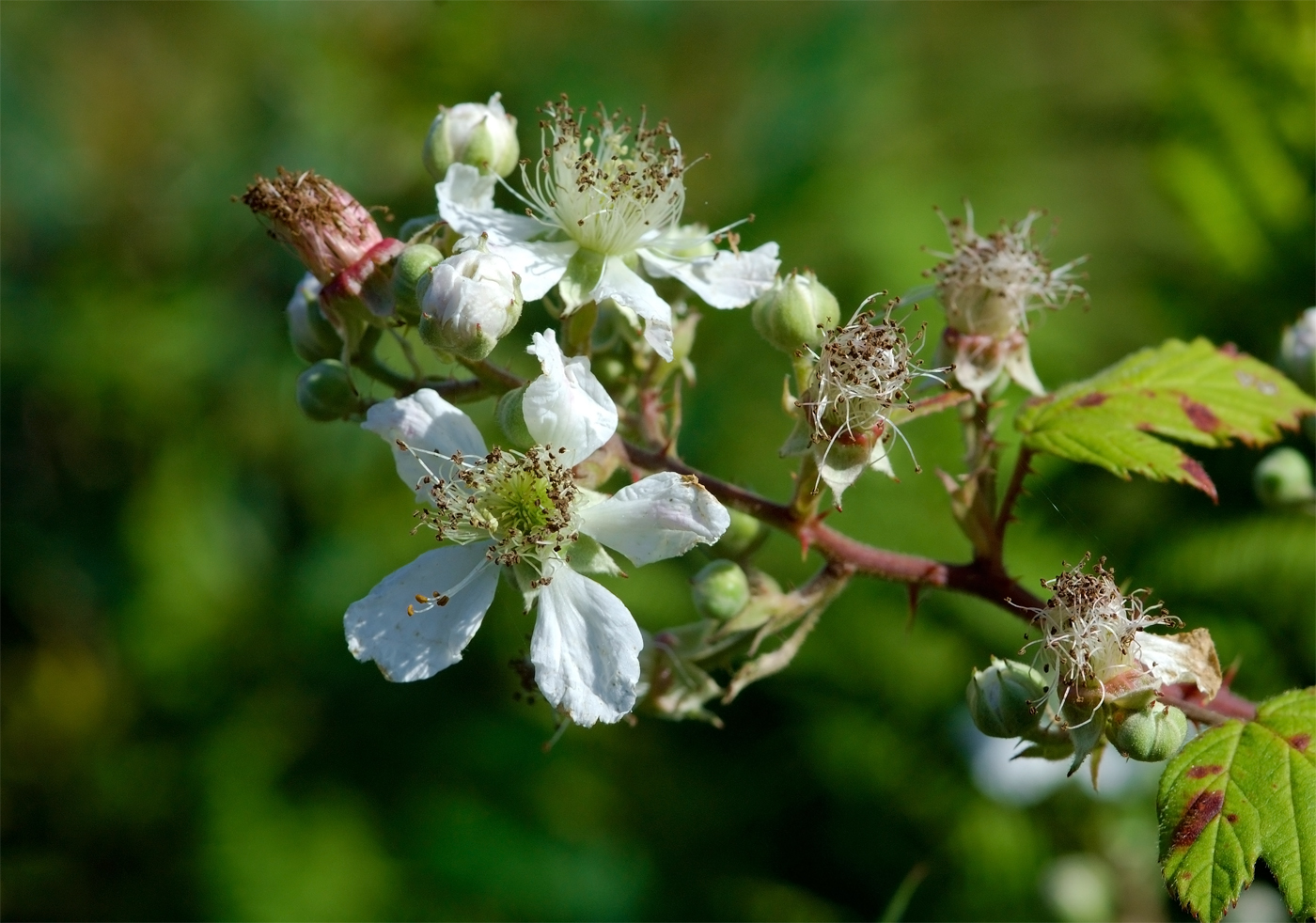
Bramble (Rubus fruticosus)
Bog Myrtle (Myrica gale)
Bog Myrtle (
Myrica gale) is an unusual plant: a sweetly aromatic, waxy-leafed, dwarfed tree (of the Order Fagales which includes Birches and Beeches) with symbiotic
Frankia bacteria in its root nodules which fix nitrogen into the soil, enabling it to grow in nutrient-poor bogs.
These peculiar mini-trees are dioecious, which means that each individual is either male or female and that both sexes are required for reproduction.
The richly resinously perfumed leaves were once used to flavour beer and soups (Bog Myrtle is abortifacient and should NOT be consumed by pregnant women!).
Candles can be made from the fragrant wax obtained by boiling the leaves/fruit and skimming off the floating waxy layer.
Bog Myrtle leaves contain insect-repellent compounds and have been used for centuries to ward off the formidable Scottish midge (which, from my own experience, is completely undeterred by DEET strong enough to melt plastic in seconds!).
Rosebay Willowherb (Epilobium angustifolium)
Sneezewort (Achillea ptarmica)
Rowan (Sorbus aucuparia)
Along the forest track to Ardmore Bay, we saw numerous butterflies: Common Blues, Speckled Woods, Dark Green Fritillaries, Scotch Argus and Graylings.
Dark Green Fritillary (Argynnis aglaja)
Dark Green Fritillary (Argynnis aglaja)
Named after the Latin word for 'dice-box' (fritillus), the fritillary 'group' of butterflies have bright orange uppersides with delicate black chequering. The undersides of the Dark Green Fritillary's wings are mossy green with silver spots.
Grayling (Hipparchia semele)
Grayling (Hipparchia semele)
The Grayling is a coastal butterfly with stony-grey undersides to its wings. This species always rests with wings closed and the rich brown uppersides of its wings are rarely seen.
Scotch Argus (Erebia aethiops)
In Britain & Ireland, the Scotch Argus' distribution is restricted to Scotland and 2 locations in Northern England.
Its scientific name describes its dark chocolate colouration:
Erebia = from Erebus, the Greek god of darkness, and
aethiops = Ethiopian.
Speckled Wood (Pararge aegeria)
Curiously absent from most of central Scotland, the Speckled Wood is a butterfly of woodland habitats and is the only British butterfly known to overwinter in both larval and pupal stages.
At Ardmore we found a group of abandoned cottages, their derelict gardens overgrown with raspberry and fuschia.
We followed a track down to Ardmore Bay; a sheltered, rocky shore preceded by rough grassland and heather; where we had lunch at a picnic table.
Creeping Willow (Salix repens)
Devil's-bit Scabious (Succisa pratensis)
Grass of Parnassus (Parnassia palustris)
Grass of Parnassus (Parnassia palustris)
Grass of Parnassus (Parnassia palustris)
Grass of Parnassus (Parnassia palustris)
Grass of Parnassus (Parnassia palustris)
Heath Pea (Lathyrus linifolius)
Heath Pea (Lathyrus linifolius)
As we were sitting at the Ardmore Bay picnic table, we watched the skies: a Buzzard soared over, mobbed by a pair of Ravens. A shortwhile later, another (more distant) bird of prey appeared, soaring with broad, fingered wings and a wedge-shaped tail...our first White-tailed Eagle!
These 'flying barn doors' weigh up to 5.5kg with a wingspan of 2.2 metres.
White-tailed Eagle (Haliaeetus albicilla)
White-tailed Eagle (Haliaeetus albicilla)
On the coastal path at Ardmore Bay we found a dead Slow-worm (
Anguis fragilis), fragile indeed, it appeared to have been pecked to death whilst basking on the path and heavily pregnant (these leg-less lizards give birth to gold-striped live young).
Slow-worm (Anguis fragilis)
Slow-worm (Anguis fragilis)
Slow-worm (Anguis fragilis) dorsal surface
Slow-worm (Anguis fragilis) dorsal surface
Slow-worm (Anguis fragilis) ventral surface
Larch Ladybird (Aphidecta obliterata)
I searched along crumbling walls and bracken for further Slow-Worms and emerged unsuccessful, my clothes covered in hundreds of tiny ticks. Turning my attention to the shore, I hunted the rock pools and caught some interesting creatures.
Goose Barnacle (Lepas pectinata) spinose form
Goose Barnacle (Lepas pectinata) spinose form
The strange lifeform above is the 'spinose variety' of the Goose Barnacle
Lepas pectinata. Astonishinly, it may have floated all the way from the Americas in a margarine tub (via the Gulf Stream). It is a tropical species, unsuited to our winters and destined to perish - I pushed its plastic vessel back out to sea, though I doubt it will be making a return journey.
Sea Gooseberry (Pleurobrachia pileus)
Sea Gooseberries or Comb Jellies are not jellyfish (phylum Cnidaria), belonging instead to the phylum Ctenophora. They are pelagic hunters of zooplankton and move using 8 rows of beating cilia (combs of tiny hairs) which give these otherwise translucent animals a shimmering, rainbow-sheen.
This species has a long pair of tentacles covered with colloblasts (sticky cells) which it uses to trap prey and can be retracted into the body cavity (which my specimen seems to have done).
Pleurobrachia pileus, like most ctenophores, is a hermaphrodite and normally reaches peak numbers from October to November.
Strigose Squat Lobster (Galathea strigosa)
Strigose Squat Lobster (Galathea strigosa)
Strigose Squat Lobster (Galathea strigosa)
Strigose Squat Lobster (Galathea strigosa)
Strigose Squat Lobster (Galathea strigosa)
I managed to find a white plastic tub amongst the flotsam which provided an excellent clean background for photography and enabled me to use flash to bring up the detail & colours.
Squat Lobsters are actually more closely related to Porcelain Crabs and Hermit Crabs than true Lobsters.
The Strigose Squat Lobster's genus name
Galathea, refers to the sea-nymph Galatea from Ovid's Metamorphoses and
strigosa means 'a row of grain' (Latin), describing the animal's bristle-covered carapace.
Goldenrod (Solidago virgaurea)
Goldenrod (Solidago virgaurea)
Goldenrod (Solidago virgaurea)
Goldenrod has been used for centuries to treat a range of ailments including urinary tract infections, skin wounds/bleeding, skin infections, whooping cough and influenza. Its leaves contain antifungal saponins and anti-inflammatory phenolic glycosides, and are mildly diuretic.
The flowers also yield a rich, golden-yellow dye.
Dyeing with Goldenrod:
Sheepy Hollow Farm Life - how to make Goldenrod dye & the effects of adding alum, iron etc on the colour.
Our Little Nature Nest - how to make Goldenrod dye.
Wild Colours - useful tips for dyeing with Goldenrod.
Hi There Hammy - photos of Goldenrod-dyed yarns with and without mordants.
Ardmore Lighthouse solar panels
We followed a path from Ardmore Lighthouse back into the forest. On the brackened hill above the sea I found a furry, orange-striped Fox Moth caterpillar.
Palmate Newt (Lissotriton helveticus)
Palmate Newt (Lissotriton helveticus)
Raven (Corvus corax)
Raven (Corvus corax)
Large Black Slug (Arion ater) brown form
Flocks of Swallows attended the open water tanks at a waste processing plant outside Tobermory - fattening themselves up and moulting into fresh new plumage in preparation for their journey back to Africa.
Swallows (Hirundo rustica)
Swallows (Hirundo rustica)
Purple Loosestrife (Lythrum salicaria)
Another wildplant with medicinal properties, Purple Loosestrife contains antimicrobial compounds (such as vescalagin), is styptic (stops bleeding) and strongly astringent (>10% tannin content).
Being non-toxic, it was traditionally used internally to treat diarrhoea, dysentery, enteritis and excessive menstruation. Externally, it can be used to treat wounds and impetigo.