Saturday, 26 September 2009

Kilpatrick Hills, West Dunbartonshire

The summer is fading fast... now is the time to appreciate the last explosions of colour and life before the onset of winter. This is berry-picking and fungi-foraying time. My mum makes jelly and jam every year from the local wild fruits. We went together to have a look at the old Crab Apple trees to the SW of Little Round Top.


On the way, we passed the old Bullace (Prunus domestica subsp. insititia) hedges at the bottom of Beeches Road (near the Gas Station). The branches were crammed with unusually large Bullaces.

Bullace (Prunus domestica insititia)

The Bullace and the Damson are both primitive varieties of the Plum (Prunus domestica). The taste of a Bullace is like a slightly less sour version of the Sloe (Prunus spinosa). Very slightly less sour, still not what I would call edible. They make a lovely jam though!

My mum also makes jam/jelly out of Elderberries (Sambucus nigra), Dog Rose-hips (Rosa canina), Brambles (Rubus fruticosus), Hawthorn (Crataegus monogyna) and Rowan (Sorbus aucuparia).

Elder (Sambucus nigra)

The edible fruits of the Elder (Sambucus nigra) can be used to make pies/tarts, jam and fruit wine. The berries have an unpleasant bitter/acidic taste and when boiled up they smell like musty old socks.

The ripe berries and flowers are edible but the rest of the plant is poisonous and contains cyanogenic glycoside sambunigrin. The bark contains calcium oxalate crystals (CaC2O4) which are also highly poisonous.

We were disappointed to find that the Crab Apple trees bore no fruit at all this year.

At this point I headed on up into the hills on my own to look for fungi.

In the field near the old piggery (now abandoned) I disturbed a Brown hare (Lepus europaeus).
Bramble (Rubus fruticosus)

Dog Roses (Rosa canina) are also fruiting:
Dog Rose (Rosa canina)
The banana-like pods below, belong to the Yellow Flag (Iris pseudacorus):
Yellow Flag (Iris pseudacorus) seed-pods

Devil's Bit Scabious (Succisa pratensis) and Marsh Ragwort (Senecio aquaticus) are flowering at Little Round Top.
Marsh Ragwort (Senecio aquaticus)
Devil's Bit Scabious (Succisa pratensis)
Devil's Bit Scabious (Succisa pratensis) was used in times past to treat scabies and other skin afflictions: 'scabious' comes from the Latin word 'scabere', meaning 'to scratch'.

I walked to the Hidden Valley (Haw Craig) and followed the strip of oak and birch woodland which extends from the top of Glenarbuck to the quarry at Rigangower. I collected a sample specimen of each mushroom species I came across.


Fungal Foray!

Here are the fungi I collected - the fungi look a bit withered because it took me hours to identify some of them.


Common Earthball (Scleroderma citrinum)

Common Earthball (Scleroderma citrinum)


These Common Earthballs (Scleroderma citrinum) were collected in the oak/birch wood above Glenarbuck. The scientific name means 'hard-skin lemon-yellow' (Sclero = hard + derma = skin, citrinum = lemon-yellow). This fungus is inedible.

Bonnet Mycena (Mycena galericulatus)
The Bonnet Mycena (Mycena galericulata) was collected from above Glenarbuck, it is said to be 'edible but not worthwhile'.

Earthy Powder-cap (Cystoderma amianthinum)

The Earthy Powder-cap (Cystoderma amianthinum), also collected above Glenarbuck, is not edible. Its latin name means 'blister-skin like-asbestos' (Cysto = blister/vesicle + derma = skin, amianthinum = like/of asbestos).

Blackening Waxcap (Hygrocybe conica)

The Blackening Waxcap (Hygrocybe conica) was collected from the rough grassland at Haw Craig. The edibility of this species is uncertain. The flesh is yellow and bruises black, giving it a charred look.

Amethyst Deceiver (Laccaria amethystea)

The vivid violet colour of the Amethyst Deciever (Laccaria amethystea) fades with age: these specimens (collected at Glenarbuck) have lost most of their colour. This species is edible.

Hypholoma sp.
Hypholoma sp.
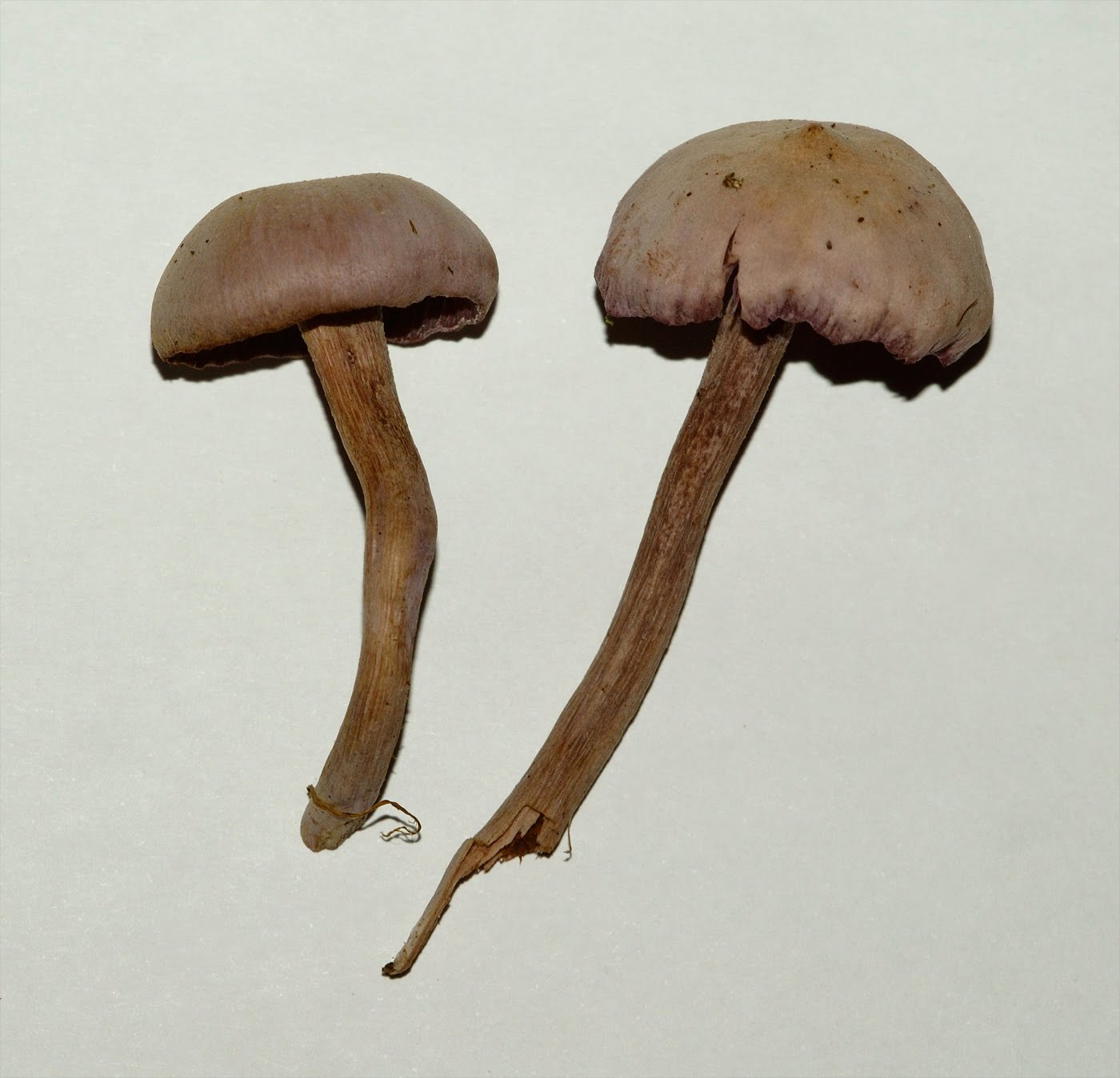
Russula sp. (possibly cyanoxantha or xerampelina?)
Egghead Mottlegill (Panaeolus semiovatus) 
Egghead Mottlegill (Panaeolus semiovatus)

I collected the Egghead Mottlegill (Panaeolus semiovatus) from the rough grassland at Haw Craig - this species is inedible.

Sunday, 16 August 2009

Kilpatrick Hills, West Dunbartonshire

With the intention of looking for basking adders, I walked from Duntocher to the Humphrey, past the Lily Loch and over to Burncrooks reservoir, past the Kilmannan reservoir and then back home (via the Humphrey again).

Yellow Shell Moth (Camptogramma bilineata)
Hogweed (Heracleum sphondylium) was flowering all along Beeches Road, the white, flat-topped umbels atrracting a multitude of insects.

At first glance, umbellifer species seem indistinguishable but with a bit of practice they are easy to tell apart - the key identifying features of Hogweed are its large size & sturdiness, the petals of the outer flowers are larger, unequal and deeply notched, and the leaves are broad-lobed and slightly hairy.

Hogweed contains furanocoumarins: these have phototoxic properties (cause damage to the skin when exposed to light). Despite this, the young stems and roots are said to be edible when cooked (celery also contains furanocoumarins) - but maybe not in large quantities...
Hogweed (Heracleum sphondylium)
Meadowsweet (Filipendula ulmaria)
Meadowsweet (Filipendula ulmaria) has a sweetly scented, creamy-popcorn-coloured froth of flowers which can be dried for use in herbal teas or made into a syrup for flavouring drinks/deserts. The leaves are also aromatic and can be used to flavour soups or dried for herbal tea.

Meadowsweet contains salicylaldehyde which can oxidise to form salicylic acid (similar to the active component of aspirin) which is a mild painkiller. For this reason, and also for its antiseptic properties, meadowsweet has been used for centuries to treat mouth ulcers, acne, heartburn and peptic ulcers, amongst other ailments.

Meadowsweet recipes (tempting eh?)

Meadowsweet & vanilla panna cotta: http://www.eatweeds.co.uk/meadowsweet-vanilla-panna-cotta

Meadowsweet sorbet: http://www.eatweeds.co.uk/meadowsweet-sorbet-recipe

Approaching the Humphrey, I passed a field full of young Aberdeen Angus bulls - of which I was terrified. They were very excited when they saw me (presumably expecting to be fed) and began aglloping about and following me along the fence. I could not shake off the fear that the fence might peter out at some point...

At the Humphrey there were plenty of Common Blue Damselflies (Enallagma cyathigerum), delicately perched on reeds or basking on the stony path. I walked towards the pond next to the Humphrey but had to retrace my steps carefully as the ground was thronging with hundreds of tiny toadlets. Surely some of these are the offspring of the toads that my dad and I rescued this spring? I like to think so :)
Toad (Bufo bufo)
Toad (Bufo bufo)
Lily Loch
The Lily Loch

The dark peaty waters of the Lily Loch were afloat with lily pads and the air was buzzing with dragonflies, damselflies and clegs.

As I sat on the banks of the Lily Loch I could hear the yickering/laughing calls of the pair of Little Grebes (Tachybaptus ruficollis) which have nested here this year. They were very secretive, hiding in the vegetation at the opposite side from me.

The lily pads belong to the Yellow Water Lily (Nuphar lutea):
Yellow Water Lily (Nuphar lutea)

Species of dragonfly/damselfly I spotted at this site were: Large Red Damselfly, Common Blue Damselfly (of which there were many), Blue-tailed Damselfly, Four-Spotted Chaser (also very numerous) and an Aeshna species (I was unable to get close enough for a proper identification).
Common Blue Damselfly (Enallagma cyathigerum) male

The Clegs (Haematopota pluvialis) were driving me mad at the Lily Loch - extra strong DEET doesn't deter them, you actually have to physically beat them off! I followed the burn that feeds into Burncrooks reservoir - New Zealand Willowherb (Epilobium brunnescens), an introduced species, grows on the rocks here.

On Burncrooks reservoir there was a family of Canada Geese (Branta canadensis), a few Greylag Geese (Anser anser), and a lone Linnet (Carduelis cannabina) darting about on the rocky banks.

The ledge above the dam was brightly coloured with White Clover(Trifolium repens), Red Clover (Trifolium pratense), Lesser Trefoil (Trifolium dubium) and Slender St. John's Wort (Hypericum pulchrum). The buds of Slender St. John's Wort are vibrantly scarlet-dipped.
Slender St John's Wort (Hypericum pulchrum)
Slender St. John's Wort (Hypericum pulchrum)
Red Clover (Trifolium pratense)
White Clover (Trifolium repens)

There were plenty of large Gold-ringed Dragonflies (Cordulegaster boltonii) zooming around Burncrooks and I managed to creep up on this handsome male, as he rested in the heather.
Gold-ringed Dragonfly (Cordulegaster boltonii) male

This magnificent insect is about 7-8cm in length and is the only yellow and black dragonfly found in Scotland. Its scientific name means 'Bolton's clubbed-belly' (Cordule, from Greek kordylinus = clubbed, gaster = belly).

After this encounter, it was time to walk homewards. I followed the path through the coniferous plantation on the Eastern side of Burncrooks reservoir. At the side of this path there is a collection of gravelly ponds (flooded quarry) where I have seen Emerald Damselflies (Lestes sponsa) in the past. I decided to search these ponds another day as there were lots of forestry commission vehicles parked around this area and warning signs have recently been put up to keep people away (I'll go back when it's quieter!). I had a brief glimpse of a flock of Jays (Garrulus glandarius) as I walked through the plantation.

There's a major tree-felling operation going on around the Kilmannan reservoir and I went to investigate the cleared land - it currently looks a bit post-apocalyptic: churned up earth, deep trenches, bits of tree/logs/stumps strewn everywhere. If I was a kid I'd probably have the time of my life playing amidst this destruction, heh! Some of the ditches had formed algae-ed ponds already - a new habitat in the process of creation.

Traversing this ravaged landscape I came across a young Dunnock (Prunella modularis) perched on a felled tree.
Dunnock (Prunella modularis)
Dunnock (Prunella modularis) immature
Dunnock (Prunella modularis)
Dunnock (Prunella modularis) immature
Dunnock (Prunella modularis)
Dunnock (Prunella modularis) immature

Dunnocks are strange little birds - they are always creeping about, rodent-like in the undergrowth, but quite often they'll come right up to you and seem almost tame.

Although drab and inconspicuously-plumaged, Dunnocks have a relatively unusual breeding system. Dunnocks are commonly polyandrous (2 or 3 males mate with and care for the offspring of 1 female), polygynous (1 male and 2 females) and polygynandrous (2 or 3 males with 2 - 4 females). Of course, they may also be monogamous (forming a pair: 1 male and 1 female) - the typical system in most birds.

Blackface sheep
River Clyde
The River Clyde

Thursday, 9 July 2009

Kilpatrick Hills, West Dunbartonshire

Today I walked to the Hidden Valley aka the Haw Craig cliffs to be absolutely sure that there are no Badgers in the area - I've always hoped to see Badgers in the Kilpatrick Hills but there doesn't seem to be any, whether due to lack of suitable habitat or persecution (or both).

The Haw Craig valley is a great spot - very secluded and quiet! No one ever seems to venture down there and the boulder scree is a nice sun-trap.

On my way up to the Haw Craig cliffs the road was fringed with flowering thistles and I stopped to take some quick photos. The three most common species in this area are: Creeping Thistle (Cirsium arvense), Marsh Thistle (Cirsium palustre) and Spear Thistle (Cirsium vulgare).

Here's how to identify them! Firstly, the Creeping Thistle (Cirsium arvense):

Creeping Thistle (Cirsium arvense)
The Creeping Thistle can be easily distinguished by its pale lilac flowers and the lack of spines on the stems. The flowers have a strong, honey-like fragrance.

Next, the Marsh Thistle (Cirsium palustre):

Marsh Thistle (Cirsium palustre)

This species has dark purple flowers, spiny-winged stems, and the flower bracts are short-spined and purplish. The florets (petals) are longer than those of the Creeping Thistle.

Lastly, the Spear Thistle (Cirsium vulgare):

Spear Thistle (Cirsium vulgare)

The Spear Thistle has significantly larger flowers than the previously mentioned species and the flowers are purplish-magenta in colour. The stems are spiny-winged and the flower bracts are green and long-spined. The flower is very globe-shaped.

The roots and peeled stems of these thistles are edible when cooked and are supposed to taste similar to Jerusalem Artichoke. I don't know whether they'd be worthwhile harvesting though (by the time you remove all the spines and roughage).

Also flowering along the Humphrey Road were Upright Hedge Parsley (Torilis japonica), Meadowsweet (Filipendula ulmaria) and Sneezewort (Achillea ptarmica).

Sneezewort (Achillea ptarmica)

Sneezewort (Achillea ptarmica) is related to Yarrow and the entire plant is highly aromatic. The scientific name refers to the use of the dried, powdered leaves as a sneezing-powder (ptarmicus = to cause sneezing).

I sat down on the edge of the Haw Craig cliffs to watch the Buzzards (Buteo buteo) soaring in the sunshine. I lay down in the grass and they circled low overhead - to see what I was up to. It was amazing to sit there with my flask of coffee and some chocolate and just watch these handsome birds enjoying the air.

Buzzard (Buteo buteo)

The grasses are looking gorgeous right now, in shades of gold, mauve and pink. They have such a subtle beauty which is often overlooked. The more I look at grasses, the more I realise that there are so many species - I wish I had a book to identify them.


All around me, the air was filled with the soft chorus of churring grasshoppers, safely hidden in the grasses. One frequently encountered species is the Common Green Grasshopper (Omocestus viridulus) - it produces a sound somewhat like 'an approaching moped' (Collins Guide to the Insects of Britain and Western Europe: Michael Chinery).

Common Green Grasshopper (Omocestus viridulus)

Foxgloves (Digitalis purpurea), Wood Sage (Teucrium scorodonia) and Slender St. John's-wort (Hypericum pulchrum) were growing over the boulder-scree and crumbling dry-stone wall. I looked for lizards as I'd always thought this seemed like ideal habitat for them - no luck.

A female Common Darter (Sympetrum striolatum) landed briefly on a stone but moved off before I was able to photograph her.

Bramble (Rubus fruticosus)

Fighting through the dense undergrowth in the Hidden Valley was very arduous, to say the least.
Head-high Bracken, powerful Bramble vines snaking around my legs and holding me fast with their barbarous blood-letting thorns, ridiculously tall Stinging Nettles threatening to burn my eyes and face at every turn, inch-long woody Hawthorn spines raking my face and catching in my hair, and finally - treacherous, ankle-breaking boulder-scree, disguised with thick plant growth.

Nearer the bottom, the undergrowth and boulders disappeared and the going was easier. At this point the forest is mainly mature Sycamore trees. No evidence of any Badgers, sadly.

At the very bottom, not far from Bowling, I sat in a small clearing (can't be far from the main road). In the grass there were Wild Strawberries (Fragaria vesca) with tiny sweet red berries.

crab-spider (Xysticus cristatus) female
Enchanter's Nightshade (Circaea lutetiana)
Self-heal (Prunella vulgaris)

Self-heal is a small plant with deep plum-purple flowers and is frequently found in meadows/lawns. The common name suggests that it was used traditionally to treat ailments of some kind - it is edible and the bitter leaves can be eaten raw or made into a tea.

I walked back up through the forested valley to look for fungi and the Buzzards of Haw Craig followed me - mewing loudly.

Dead Moll's Fingers (Xylaria longipes)

I found a Sycamore log which was absolutely covered with huge Dryad's Saddles (Polyporus squamosus). They are an edible species but are said to have little taste and older specimens are very tough and chewy. I am thinking about collecting some as I'd like to try batter-frying them...

Dryad's Saddle (Polyporus squamosus)
Harebell (Campanula rotundifolia)

The sky started to darken so I headed home. Back in Glasgow, I found a male Poplar Hawkmoth (Laothoe populi) in my kitchen - the second this year (we don't get many moths in the city so I was excited!). I rescued him before any squeamish flatmates were shocked at the discovery of a 'monster-moth'!

Poplar Hawkmoth (Laothoe populi) male