Monday, 28 December 2009

Kilpatrick Hills, West Dunbartonshire

This week we experienced the deepest snow-fall in over 20 years - waist-high in parts of the Kilpatrick Hills!

Keen to look for tracks and trails - my dad and I took a circular route up to the Greenside Reservoir and back.

Above the layer of fog which lay across Glasgow and the Clyde valley, the sky was clear azure-blue and the snow sparkled brilliantly in the sunshine.

The hills were transformed by the snow, mist and sun, into an almost lunar landscape - our footprints were the first human ones on this unfamiliar terrain.


Kilpatrick Hills snow


Kilpatrick Hills snow

Kilpatrick Hills snow


Further into the hills, the snow proved a real challenge to walk through.

Walking up the Cochno Hill towards the Greenside, a foraging flock of Reed Buntings (Emberiza scheoniclus) alighted on the snow ahead of us.

Kilpatrick Hills reed bunting
Reed Bunting (Emberiza schoeniclus) female

The view from the Greenside was spectacular! Duncolm is a volcanic plug - at 401 metres it is the highest point in the Kilpatrick Hills. Covered with snow, it somewhat resembled a huge dumpling, dusted with icing sugar! Yum!
*now craving mum's home-made dumpling*

...EXACTLY the sort of high energy food you should bring with you on a hike like this!

Duncolm
View of Duncolm
Greenside Reservoir
Greenside Reservoir
The snow really brings out the textures of grasses and reeds:


Bracken in snow


In the snow, even shy and reclusive animals cannot help but leave a record of their movements.

These footprints (at Little Round Top) belong to a Pheasant (Phasianus colchicus):

Pheasant footprints
Pheasant (Phasianus colchicus) footprints
These tiny footprints (below) most likely belong to either a Bank Vole or Field Vole (no tail drag - unlike a Wood Mouse's footprints).

Vole footprints
Vole footprints
We found these much larger tracks near the Greenside Reservoir - they belong to a Brown Hare (Lepus europaeus). The distance between strides was over 2 metres!! These graceful long-legged gallopers have a very different gait from rabbits.

Brown Hare footprints
Brown Hare (Lepus europaeus) footprints
Brown Hare footprints
Brown Hare (Lepus europaeus) footprints
These large, long-clawed footprints belong to a Grey Squirrel (Sciurus carolinensis): note the lack of tail drag.
Grey Squirrel footprints
Grey Squirrel (Sciurus carolinensis) footprints

Saturday, 26 September 2009

Kilpatrick Hills, West Dunbartonshire

The summer is fading fast... now is the time to appreciate the last explosions of colour and life before the onset of winter. This is berry-picking and fungi-foraying time. My mum makes jelly and jam every year from the local wild fruits. We went together to have a look at the old Crab Apple trees to the SW of Little Round Top.


On the way, we passed the old Bullace (Prunus domestica subsp. insititia) hedges at the bottom of Beeches Road (near the Gas Station). The branches were crammed with unusually large Bullaces.

Bullace (Prunus domestica insititia)

The Bullace and the Damson are both primitive varieties of the Plum (Prunus domestica). The taste of a Bullace is like a slightly less sour version of the Sloe (Prunus spinosa). Very slightly less sour, still not what I would call edible. They make a lovely jam though!

My mum also makes jam/jelly out of Elderberries (Sambucus nigra), Dog Rose-hips (Rosa canina), Brambles (Rubus fruticosus), Hawthorn (Crataegus monogyna) and Rowan (Sorbus aucuparia).

Elder (Sambucus nigra)

The edible fruits of the Elder (Sambucus nigra) can be used to make pies/tarts, jam and fruit wine. The berries have an unpleasant bitter/acidic taste and when boiled up they smell like musty old socks.

The ripe berries and flowers are edible but the rest of the plant is poisonous and contains cyanogenic glycoside sambunigrin. The bark contains calcium oxalate crystals (CaC2O4) which are also highly poisonous.

We were disappointed to find that the Crab Apple trees bore no fruit at all this year.

At this point I headed on up into the hills on my own to look for fungi.

In the field near the old piggery (now abandoned) I disturbed a Brown hare (Lepus europaeus).
Bramble (Rubus fruticosus)

Dog Roses (Rosa canina) are also fruiting:
Dog Rose (Rosa canina)
The banana-like pods below, belong to the Yellow Flag (Iris pseudacorus):
Yellow Flag (Iris pseudacorus) seed-pods

Devil's Bit Scabious (Succisa pratensis) and Marsh Ragwort (Senecio aquaticus) are flowering at Little Round Top.
Marsh Ragwort (Senecio aquaticus)
Devil's Bit Scabious (Succisa pratensis)
Devil's Bit Scabious (Succisa pratensis) was used in times past to treat scabies and other skin afflictions: 'scabious' comes from the Latin word 'scabere', meaning 'to scratch'.

I walked to the Hidden Valley (Haw Craig) and followed the strip of oak and birch woodland which extends from the top of Glenarbuck to the quarry at Rigangower. I collected a sample specimen of each mushroom species I came across.


Fungal Foray!

Here are the fungi I collected - the fungi look a bit withered because it took me hours to identify some of them.


Common Earthball (Scleroderma citrinum)

Common Earthball (Scleroderma citrinum)


These Common Earthballs (Scleroderma citrinum) were collected in the oak/birch wood above Glenarbuck. The scientific name means 'hard-skin lemon-yellow' (Sclero = hard + derma = skin, citrinum = lemon-yellow). This fungus is inedible.

Bonnet Mycena (Mycena galericulatus)
The Bonnet Mycena (Mycena galericulata) was collected from above Glenarbuck, it is said to be 'edible but not worthwhile'.

Earthy Powder-cap (Cystoderma amianthinum)

The Earthy Powder-cap (Cystoderma amianthinum), also collected above Glenarbuck, is not edible. Its latin name means 'blister-skin like-asbestos' (Cysto = blister/vesicle + derma = skin, amianthinum = like/of asbestos).

Blackening Waxcap (Hygrocybe conica)

The Blackening Waxcap (Hygrocybe conica) was collected from the rough grassland at Haw Craig. The edibility of this species is uncertain. The flesh is yellow and bruises black, giving it a charred look.

Amethyst Deceiver (Laccaria amethystea)

The vivid violet colour of the Amethyst Deciever (Laccaria amethystea) fades with age: these specimens (collected at Glenarbuck) have lost most of their colour. This species is edible.

Hypholoma sp.
Hypholoma sp.
Russula sp. (possibly cyanoxantha or xerampelina?)
Egghead Mottlegill (Panaeolus semiovatus) 
Egghead Mottlegill (Panaeolus semiovatus)

I collected the Egghead Mottlegill (Panaeolus semiovatus) from the rough grassland at Haw Craig - this species is inedible.

Sunday, 16 August 2009

Kilpatrick Hills, West Dunbartonshire

With the intention of looking for basking adders, I walked from Duntocher to the Humphrey, past the Lily Loch and over to Burncrooks reservoir, past the Kilmannan reservoir and then back home (via the Humphrey again).

Yellow Shell Moth (Camptogramma bilineata)
Hogweed (Heracleum sphondylium) was flowering all along Beeches Road, the white, flat-topped umbels atrracting a multitude of insects.

At first glance, umbellifer species seem indistinguishable but with a bit of practice they are easy to tell apart - the key identifying features of Hogweed are its large size & sturdiness, the petals of the outer flowers are larger, unequal and deeply notched, and the leaves are broad-lobed and slightly hairy.

Hogweed contains furanocoumarins: these have phototoxic properties (cause damage to the skin when exposed to light). Despite this, the young stems and roots are said to be edible when cooked (celery also contains furanocoumarins) - but maybe not in large quantities...
Hogweed (Heracleum sphondylium)
Meadowsweet (Filipendula ulmaria)
Meadowsweet (Filipendula ulmaria) has a sweetly scented, creamy-popcorn-coloured froth of flowers which can be dried for use in herbal teas or made into a syrup for flavouring drinks/deserts. The leaves are also aromatic and can be used to flavour soups or dried for herbal tea.

Meadowsweet contains salicylaldehyde which can oxidise to form salicylic acid (similar to the active component of aspirin) which is a mild painkiller. For this reason, and also for its antiseptic properties, meadowsweet has been used for centuries to treat mouth ulcers, acne, heartburn and peptic ulcers, amongst other ailments.

Meadowsweet recipes (tempting eh?)

Meadowsweet & vanilla panna cotta: http://www.eatweeds.co.uk/meadowsweet-vanilla-panna-cotta

Meadowsweet sorbet: http://www.eatweeds.co.uk/meadowsweet-sorbet-recipe

Approaching the Humphrey, I passed a field full of young Aberdeen Angus bulls - of which I was terrified. They were very excited when they saw me (presumably expecting to be fed) and began aglloping about and following me along the fence. I could not shake off the fear that the fence might peter out at some point...

At the Humphrey there were plenty of Common Blue Damselflies (Enallagma cyathigerum), delicately perched on reeds or basking on the stony path. I walked towards the pond next to the Humphrey but had to retrace my steps carefully as the ground was thronging with hundreds of tiny toadlets. Surely some of these are the offspring of the toads that my dad and I rescued this spring? I like to think so :)
Toad (Bufo bufo)
Toad (Bufo bufo)
Lily Loch
The Lily Loch

The dark peaty waters of the Lily Loch were afloat with lily pads and the air was buzzing with dragonflies, damselflies and clegs.

As I sat on the banks of the Lily Loch I could hear the yickering/laughing calls of the pair of Little Grebes (Tachybaptus ruficollis) which have nested here this year. They were very secretive, hiding in the vegetation at the opposite side from me.

The lily pads belong to the Yellow Water Lily (Nuphar lutea):
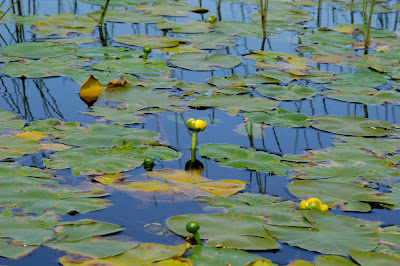
Yellow Water Lily (Nuphar lutea)

Species of dragonfly/damselfly I spotted at this site were: Large Red Damselfly, Common Blue Damselfly (of which there were many), Blue-tailed Damselfly, Four-Spotted Chaser (also very numerous) and an Aeshna species (I was unable to get close enough for a proper identification).
Common Blue Damselfly (Enallagma cyathigerum) male

The Clegs (Haematopota pluvialis) were driving me mad at the Lily Loch - extra strong DEET doesn't deter them, you actually have to physically beat them off! I followed the burn that feeds into Burncrooks reservoir - New Zealand Willowherb (Epilobium brunnescens), an introduced species, grows on the rocks here.

On Burncrooks reservoir there was a family of Canada Geese (Branta canadensis), a few Greylag Geese (Anser anser), and a lone Linnet (Carduelis cannabina) darting about on the rocky banks.

The ledge above the dam was brightly coloured with White Clover(Trifolium repens), Red Clover (Trifolium pratense), Lesser Trefoil (Trifolium dubium) and Slender St. John's Wort (Hypericum pulchrum). The buds of Slender St. John's Wort are vibrantly scarlet-dipped.
Slender St John's Wort (Hypericum pulchrum)
Slender St. John's Wort (Hypericum pulchrum)
Red Clover (Trifolium pratense)
White Clover (Trifolium repens)

There were plenty of large Gold-ringed Dragonflies (Cordulegaster boltonii) zooming around Burncrooks and I managed to creep up on this handsome male, as he rested in the heather.
Gold-ringed Dragonfly (Cordulegaster boltonii) male

This magnificent insect is about 7-8cm in length and is the only yellow and black dragonfly found in Scotland. Its scientific name means 'Bolton's clubbed-belly' (Cordule, from Greek kordylinus = clubbed, gaster = belly).

After this encounter, it was time to walk homewards. I followed the path through the coniferous plantation on the Eastern side of Burncrooks reservoir. At the side of this path there is a collection of gravelly ponds (flooded quarry) where I have seen Emerald Damselflies (Lestes sponsa) in the past. I decided to search these ponds another day as there were lots of forestry commission vehicles parked around this area and warning signs have recently been put up to keep people away (I'll go back when it's quieter!). I had a brief glimpse of a flock of Jays (Garrulus glandarius) as I walked through the plantation.

There's a major tree-felling operation going on around the Kilmannan reservoir and I went to investigate the cleared land - it currently looks a bit post-apocalyptic: churned up earth, deep trenches, bits of tree/logs/stumps strewn everywhere. If I was a kid I'd probably have the time of my life playing amidst this destruction, heh! Some of the ditches had formed algae-ed ponds already - a new habitat in the process of creation.

Traversing this ravaged landscape I came across a young Dunnock (Prunella modularis) perched on a felled tree.
Dunnock (Prunella modularis)
Dunnock (Prunella modularis) immature
Dunnock (Prunella modularis)
Dunnock (Prunella modularis) immature
Dunnock (Prunella modularis)
Dunnock (Prunella modularis) immature

Dunnocks are strange little birds - they are always creeping about, rodent-like in the undergrowth, but quite often they'll come right up to you and seem almost tame.

Although drab and inconspicuously-plumaged, Dunnocks have a relatively unusual breeding system. Dunnocks are commonly polyandrous (2 or 3 males mate with and care for the offspring of 1 female), polygynous (1 male and 2 females) and polygynandrous (2 or 3 males with 2 - 4 females). Of course, they may also be monogamous (forming a pair: 1 male and 1 female) - the typical system in most birds.

Blackface sheep
River Clyde
The River Clyde